If you are considering laser vision correction, you have likely come across two popular procedures: LASIK and PRK.
Both are effective in correcting refractive errors like myopia, hyperopia, and astigmatism, but they differ significantly in technique, recovery time, and patient suitability.
Understanding the LASIK vs PRK difference is essential before making a decision that affects your vision for life.
At Seedieye Care Center, choosing the right procedure depends on your individual eye condition, lifestyle, and long-term vision goals.
This detailed comparison will help you understand both surgeries so you can make a confident, informed choice with the guidance of our expert ophthalmologists.
What Is LASIK Surgery?
LASIK (Laser-Assisted In Situ Keratomileusis) is currently the most widely performed laser eye surgery in the world.
It reshapes the cornea with remarkable precision to correct refractive errors and reduce or eliminate the need for glasses or contact lenses.
LASIK surgery benefits are well-documented, and the procedure is known for its speed, comfort, and rapid visual recovery.
How LASIK Works
LASIK is a two-step surgical procedure that takes approximately 10 to 15 minutes per eye. Here is how it works step by step:
- A thin protective flap is created on the surface of the cornea using a microkeratome or femtosecond laser
- The flap is gently lifted to expose the underlying corneal tissue (stroma)
- An excimer laser precisely reshapes the corneal tissue based on your prescription
- The flap is carefully repositioned, where it bonds naturally without stitches
The procedure is guided by advanced mapping of your eye’s unique curvature, ensuring customised and highly accurate correction.
Benefits of LASIK
LASIK surgery benefits make it the first-choice procedure for most eligible patients. Key advantages include:
- Quick procedure — typically completed in 10 to 15 minutes per eye
- Minimal discomfort during and after surgery
- Remarkably fast recovery — most patients notice improved vision within 24 to 48 hours
- Immediate vision improvement — many patients can drive or return to work the very next day
- High precision with wavefront-guided technology for sharper outcomes
LASIK is widely performed at Seedieye Care Center using state-of-the-art laser technology for safe, precise, and personalised results.
Discover Blade-Free LASIK in Bangalore
What Is PRK Surgery?
PRK (Photorefractive Keratectomy) is the original laser vision correction procedure, predating LASIK by over a decade. Unlike LASIK, PRK does not involve creating a corneal flap.
Instead, it works directly on the corneal surface, making it a highly suitable option for patients who are not candidates for LASIK. While PRK recovery time is longer, long-term outcomes are equally excellent.
How PRK Works
PRK is a surface-based laser procedure. The process differs from LASIK in a fundamental way, there is no flap creation involved.
- The outer layer of the cornea, known as the epithelium, is gently removed
- An excimer laser is applied directly to the surface of the cornea to reshape it
- The epithelium regenerates naturally over the following days to weeks
- A temporary protective contact lens is placed on the eye to aid healing
Though the healing process is slower, the final visual outcome is comparable to LASIK in most cases.
Benefits of PRK
PRK offers distinct advantages that make it the preferred choice for specific patient groups. These benefits include:
- Suitable for patients with thin corneas who cannot safely undergo LASIK
- Eliminates flap-related complications entirely — no risk of flap dislodgement
- Ideal for athletes, military personnel, or anyone with an active physical lifestyle
- Preserves more corneal tissue, which can be beneficial for long-term eye health
- Equally effective as LASIK for correcting myopia, hyperopia, and astigmatism
PRK is often recommended at Seedieye Care Center for patients not eligible for LASIK, ensuring every patient has a safe and effective pathway to clearer vision.
LASIK vs PRK: Key Differences
When it comes to the vision correction surgery comparison between LASIK and PRK, understanding the specific differences across multiple factors helps set realistic expectations.
The table below summarises the most important distinctions.
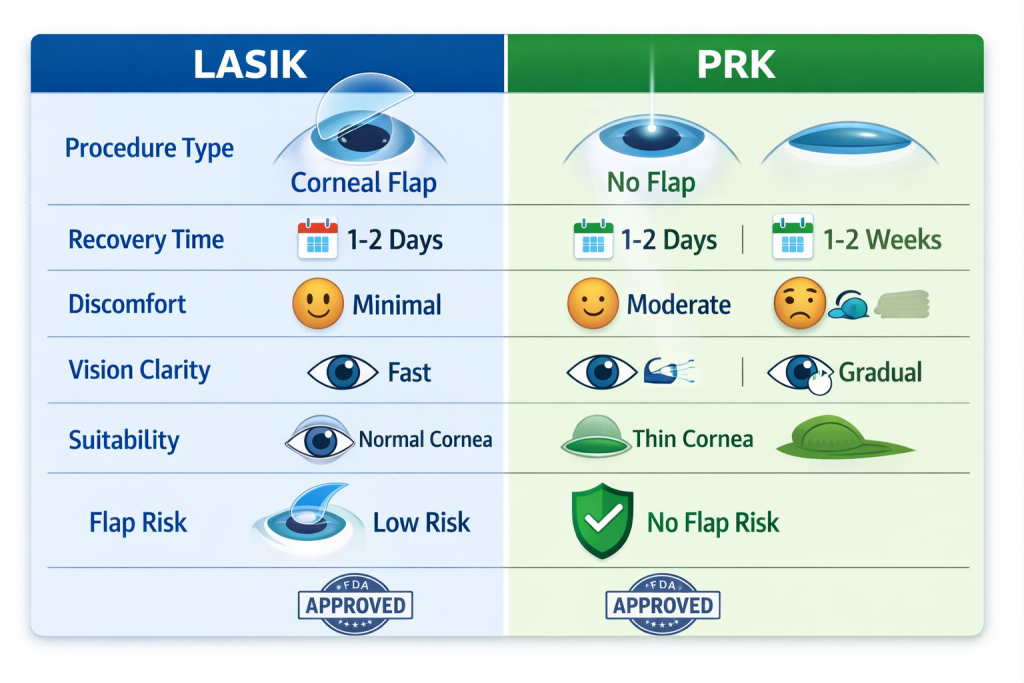
Both procedures use the same excimer laser technology to reshape the cornea. The key PRK vs LASIK difference lies in how the corneal surface is accessed, with a flap or without.
Which Surgery Is Better: LASIK or PRK?
This is the most commonly asked question in any vision correction surgery comparison, and the honest answer is that neither procedure is universally superior.
The best laser eye surgery for you depends on your individual anatomy, lifestyle, and visual needs. Here is a practical guide to help you decide.
Choose LASIK If:
LASIK may be the right choice for you if the following apply to your situation:
- You want the fastest possible recovery and minimal downtime
- You have a normal or above-average corneal thickness
- You prefer minimal discomfort throughout the healing process
- Your profession or lifestyle requires a very quick return to normal activities
- Your ophthalmologist confirms you are a suitable candidate after a full evaluation
Choose PRK If:
PRK may be the better option if your eye profile or lifestyle fits the following criteria:
- You have thin corneas that do not meet the thickness threshold for LASIK
- You are involved in contact sports, martial arts, or high-impact physical activity
- You are in the military, law enforcement, or any career with high physical risk
- You have been specifically advised against LASIK by your eye specialist
- You are comfortable with a longer recovery period in exchange for greater corneal stability
At Seedieye Care Center, doctors perform detailed pre-operative eye evaluations, including corneal topography and thickness mapping, to recommend the safest and most effective procedure for each patient.
Recovery Time: LASIK vs PRK
PRK recovery time is one of the most discussed aspects when patients compare the two procedures.
Recovery differs significantly between LASIK and PRK, and understanding what to expect can help you plan around the surgery effectively.
LASIK Recovery
LASIK is renowned for its exceptionally fast healing process. Most patients are pleasantly surprised by how quickly normal life resumes.
- Vision begins improving within 24 to 48 hours of surgery
- Most patients return to work and daily activities within 1 to 2 days
- Driving is typically possible within 1 to 2 days with surgeon clearance
- Avoid swimming, eye rubbing, and contact sports for 2 to 4 weeks
- Full stabilisation of vision occurs within 3 to 6 months
PRK Recovery
PRK recovery time is longer due to the natural regeneration of the corneal epithelium. Patients should plan accordingly, especially for the first week.
- Initial epithelial healing takes approximately 3 to 5 days
- A bandage contact lens is worn during the first few days to protect the surface
- Functional vision is usually achieved within 1 to 2 weeks
- Full visual clarity and stability may take 4 to 6 weeks or slightly longer
- Avoid strenuous physical activity for at least 3 to 4 weeks post-surgery
Although PRK recovery time is longer, the long-term visual outcomes are statistically similar to LASIK.
Many patients who opt for PRK find the extra recovery period entirely worthwhile.
Also Check: The Top 10 Best Eye Hospitals In Bangalore 2026 List
Safety and Success Rate
Patient safety is the top priority when comparing LASIK and PRK. Fortunately, both procedures have an outstanding safety record and are backed by decades of clinical data.
This is an important aspect of any vision correction surgery comparison.
- Both LASIK and PRK are FDA-approved laser vision correction procedures
- Over 95% of patients achieve 20/20 vision or better after either procedure
- Serious complications are rare, occurring in less than 1% of cases when performed by qualified surgeons
- Both procedures carry a high patient satisfaction rate, often exceeding 96%
- Risk of infection, under-correction, or over-correction is minimised with modern technology
At Seedieye Care Center, advanced diagnostic technology and experienced ophthalmologists ensure safe, precise, and consistent outcomes for every patient undergoing LASIK or PRK.
Cost Comparison: LASIK vs PRK
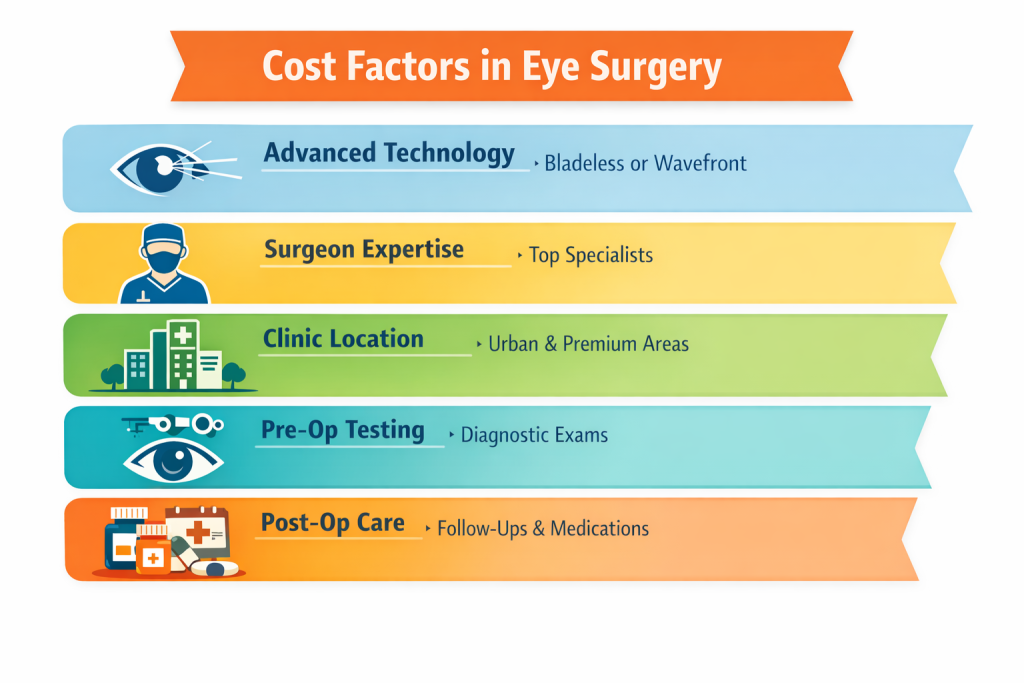
Cost is a practical consideration for many patients exploring the best laser eye surgery option.
The good news is that LASIK and PRK are generally comparable in price, though specific costs vary based on several factors.
Are You a Candidate for Laser Eye Surgery?
Not every patient qualifies for LASIK or PRK.
A thorough pre-operative evaluation is essential to determine your eligibility and identify which of the two procedures, if either, is appropriate for your eyes.
Eligibility Factors
The following criteria are typically evaluated before recommending laser vision correction:
- Age of 18 years or above, with a preference for 21 and older for greater prescription stability
- Stable vision prescription for at least 12 months prior to surgery
- Adequate corneal thickness — critical for determining LASIK vs PRK suitability
- No significant eye diseases such as keratoconus, severe dry eye, or active infections
- Pupils within acceptable size range for laser treatment
- General good health with no autoimmune conditions that could affect healing
Patients who do not qualify for LASIK due to thin corneas or high prescriptions are often excellent PRK candidates.
A comprehensive eye checkup at Seedieye Care Center is the essential first step.
Why Choose Seedieye Care Center for LASIK or PRK?
Choosing the right clinic is just as important as choosing the right procedure.
At Seedieye Care Center, we combine clinical expertise, cutting-edge technology, and compassionate patient care to deliver exceptional outcomes for every vision correction patient.
Key Advantages
Here is what sets Seedieye Care Center apart as a trusted destination for the best laser eye surgery:
- Latest laser technology — including bladeless LASIK and wavefront-guided platforms for superior precision
- Personalised treatment plans — every patient receives a tailored approach based on detailed diagnostics
- Experienced surgeons — our ophthalmologists bring years of specialised laser vision correction expertise
- High success rate — consistent outcomes with over 95% of patients achieving their target vision
- Comprehensive aftercare — dedicated follow-up support throughout your recovery journey
- Transparent consultation — honest recommendations with no pressure to opt for any specific procedure
Conclusion
Both LASIK and PRK are proven, highly effective vision correction surgeries that have helped millions of patients around the world achieve clear, glasses-free vision.
In the LASIK vs PRK debate, there is no single winner; the right choice depends entirely on your corneal health, lifestyle, and visual goals. LASIK offers speed and convenience, while PRK offers broader eligibility and flap-free safety.
If you are unsure which procedure is right for you, the most important next step is a professional evaluation.
Consult the expert team at Seedieye Care Center for a detailed, personalised assessment and a clear recommendation tailored to your eyes.
FAQs | LASIK vs PRK
Is PRK safer than LASIK?
Both PRK and LASIK are FDA-approved, highly safe procedures with excellent track records. PRK eliminates the small risk of flap-related complications entirely, which can be an advantage for patients with thin corneas or active lifestyles.
Which surgery has a faster recovery?
LASIK has a significantly faster recovery time, with most patients experiencing clear vision within 24 to 48 hours. PRK recovery time is longer, typically 1 to 2 weeks for functional vision, due to the natural regeneration of the corneal surface.
Is PRK more painful than LASIK?
PRK may involve slightly more discomfort during the first few days of healing, as the outer corneal layer regenerates. LASIK patients typically experience minimal to no discomfort after the procedure.
Are the results of LASIK and PRK permanent?
Yes, both LASIK and PRK provide long-lasting vision correction by permanently reshaping the cornea. The results are stable for the vast majority of patients, though age-related changes like presbyopia may affect near vision later in life.