If you have astigmatism and wear contact lenses, you have probably heard the word ‘toric’, but do you really know what it means and why it matters? Choosing between toric and regular contact lenses is not just a preference. It can be the difference between sharp, clear vision and constant squinting, eye strain, and blurred sight throughout the day.
This Toric vs Regular Contact Lenses guide breaks down everything you need to know about toric lenses for astigmatism vs regular spherical contact lenses, how they work, who needs them, and what to expect during fitting. Whether you are newly diagnosed with astigmatism in Bangalore or already wearing lenses that just do not seem right, this blog will help you make a confident, informed decision.
What Is Astigmatism? Understanding the Root Cause of Blurry Vision
Before comparing toric lenses vs regular contacts, it helps to understand exactly what astigmatism is and why regular spherical lenses simply cannot correct it properly.
Astigmatism is one of the most common refractive errors in the world, and a very common reason people in Bangalore visit eye specialists.
How an Irregularly Shaped Cornea Causes Astigmatism and Distorted Vision
A normal, healthy cornea is perfectly round, like a basketball. In astigmatism, the cornea (or sometimes the eye’s internal lens) is shaped more like a rugby ball or football, with different curvatures across different directions.
This irregular corneal curvature means light entering the eye does not focus on a single point on the retina. Instead, it focuses on multiple points, creating blurred, distorted, or doubled images.
Common astigmatism symptoms include:
- Distorted or blurry vision at all distances, not just near or far
- Ghosting or shadowing around letters and objects
- Halos or starbursts around lights, especially at night
- Frequent headaches after reading or screen use
- Eye strain and squinting throughout the day
- Difficulty with night driving due to light scatter
Key fact: Astigmatism is measured in diopters of cylinder (CYL) and described by an axis (in degrees 0-180). Your prescription will include both if you have astigmatism.
Thinking about vision correction options? Don’t miss our detailed guide on How to Choose the Right LASIK Surgeon in Bangalore (Checklist), a must-read before taking the next step toward glasses-free vision.
What Are Regular (Spherical) Contact Lenses? How They Correct Myopia and Hyperopia
Regular contact lenses, also called spherical lenses, are the standard lenses most people think of when they imagine contacts.
They are designed to correct straightforward refractive errors and are the most commonly prescribed type globally.
How Spherical Contact Lenses Work and Who They Are Designed For
Regular spherical contact lenses have the same corrective power uniformly distributed across the entire surface of the lens. They correct vision along a single axis, making them effective for:
- Myopia (nearsightedness): difficulty seeing objects at a distance
- Hyperopia (farsightedness): difficulty seeing objects up close
- Presbyopia: age-related difficulty with near vision (managed with multifocal spherical lenses)
Because regular lenses have a symmetrical, uniform shape, they are simpler to manufacture, less expensive, and easier to fit.
They can rotate freely in the eye without affecting vision quality, because all zones of the lens have the same power.
Important: Regular spherical contact lenses cannot correct astigmatism. Wearing them with unmanaged astigmatism leaves residual blur and contributes to eye strain, headaches, and fatigue.
What Are Toric Contact Lenses for Astigmatism? Design, Shape, and How They Correct Vision
Toric contact lenses are specially engineered contact lenses designed exclusively to correct astigmatism, with or without accompanying myopia or hyperopia.
They are fundamentally different from regular spherical contacts in their design, complexity, and the way they interact with your eye.
The Unique Dual-Curvature Design of Toric Lenses: What Makes Them Different
The word ‘toric’ refers to the shape of the lens, a torus, like a slice of a donut. This shape allows the lens to have two different curvatures across two perpendicular axes: one to correct the astigmatism, and one to correct any accompanying nearsightedness or farsightedness.
No regular spherical lens can achieve this.
Toric lenses also feature a stabilisation system to prevent rotation in the eye. If a toric lens rotates even slightly, the corrective axes shift out of alignment and vision becomes blurry. Manufacturers use two main stabilisation methods:
- Prism ballast: A slightly thicker, heavier zone at the bottom of the lens uses gravity and eyelid pressure to anchor the lens in the correct orientation
- Peri-ballast / thin-zone design: Thin areas at the top and bottom that sit beneath the eyelids, using lid pressure to hold the lens stable
A toric contact lens prescription includes three key numbers: sphere (SPH) for myopia/hyperopia correction, cylinder (CYL) for the amount of astigmatism, and axis (the orientation in degrees).
This complexity is why fitting toric lenses requires more expertise and often more trial fittings than regular lenses.
Toric vs Regular Contact Lenses: A Complete Side-by-Side Comparison for Astigmatism
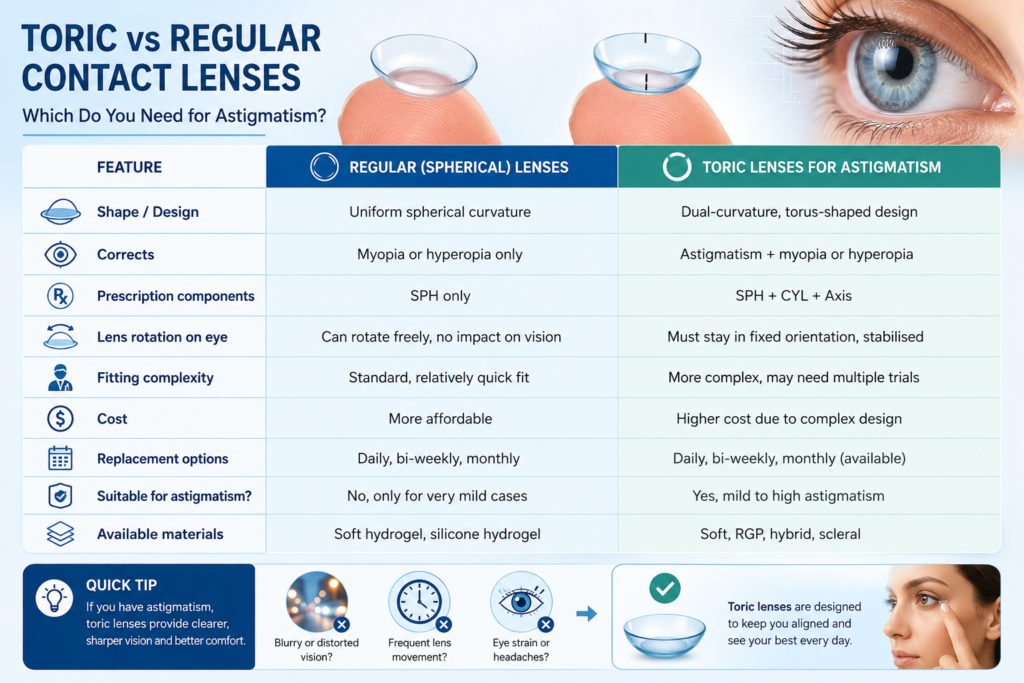
If you are trying to decide between toric and regular contacts, or wondering why your optometrist recommended toric lenses when you previously wore regular ones, this comparison table lays out all the key differences clearly.
| Feature | Regular (Spherical) Lenses | Toric Lenses for Astigmatism |
| Shape / Design | Uniform spherical curvature | Dual-curvature, torus-shaped design |
| Corrects | Myopia or hyperopia only | Astigmatism + myopia or hyperopia |
| Prescription components | SPH only | SPH + CYL + Axis |
| Lens rotation on eye | Can rotate freely, no impact on vision | Must stay in fixed orientation, stabilised |
| Fitting complexity | Standard, relatively quick fit | More complex, may need multiple trials |
| Cost | More affordable | Higher cost due to complex design |
| Replacement options | Daily, bi-weekly, monthly | Daily, bi-weekly, monthly (available) |
| Suitable for astigmatism? | No, only for very mild cases | Yes, mild to high astigmatism |
| Available materials | Soft hydrogel, silicone hydrogel | Soft, RGP, hybrid, scleral |
Sudden blurry vision or darkness in one eye shouldn’t be ignored. Read Sudden Vision Loss: When Is It an Emergency? to know the warning signs that need immediate medical attention.
Types of Contact Lenses for Astigmatism: Soft Toric, RGP, Hybrid, and Scleral Lenses
Not all toric lenses are the same. Depending on the severity of your astigmatism, your corneal shape, and your lifestyle, different types of astigmatism contact lenses may be recommended.
Understanding your options helps you have a more informed conversation with your eye specialist.
Soft Toric Contact Lenses: Comfortable Daily Wear for Mild to Moderate Astigmatism
Soft toric lenses are the most commonly prescribed contact lenses for astigmatism and are the first-line choice for most patients.
Made from flexible hydrogel or silicone hydrogel materials, they conform gently to the eye’s surface and are available as daily, bi-weekly, or monthly replacements.
- Best for: First-time lens wearers, mild to moderate astigmatism, sensitive eyes
- Comfort: High, flexible material adapts to the eye quickly
- Fitting: May require 2-3 trial pairs to find the optimal stabilisation and axis alignment
Rigid Gas Permeable (RGP) and Scleral Lenses for High Astigmatism and Irregular Corneas
For patients with high astigmatism, irregular corneal surfaces, or conditions like keratoconus, rigid gas permeable (RGP) lenses, also called hard contacts, often provide sharper vision than soft toric lenses.
This is because RGP lenses maintain their shape on the eye, effectively replacing the irregular corneal surface with a smooth optical interface.
- RGP toric lenses: Best for high or irregular astigmatism, sharper vision, but longer adaptation period
- Scleral lenses: Large-diameter rigid lenses that vault over the cornea entirely, excellent for keratoconus and complex corneas
- Hybrid lenses: Rigid RGP centre with a soft skirt, combines the clarity of RGP with the comfort of soft lenses
Note: Many patients with astigmatism report noticeably sharper vision with RGP or scleral lenses compared to soft torics, though comfort takes longer to achieve.
Can You Wear Regular Contacts With Mild Astigmatism? What Eye Specialists Say
This is one of the most common questions asked by contact lens wearers in Bangalore. The short answer: it depends on the degree of astigmatism and how much residual blur is acceptable to you.
When Mild Astigmatism May or May Not Need Toric Lenses
Some patients with very mild astigmatism (typically under 0.75 dioptres of cylinder) can wear regular spherical contacts with reasonable vision quality, especially if their dominant refractive error is myopia or hyperopia.
However, even mild uncorrected astigmatism often causes:
- Persistent eye strain and headaches during prolonged screen use
- Reduced the quality of night vision and glare sensitivity
- Gradual visual fatigue by the end of the day
- Slightly blurred vision that glasses do not seem to ‘fully’ fix
For most patients, even mild astigmatism is better corrected with toric lenses. Modern daily toric lenses are available in low cylinder powers and are a comfortable, affordable upgrade from regular contacts.
Your eye specialist is the best person to advise you based on your specific prescription and visual demands.
Get Expert Toric Lens Fitting and Astigmatism Treatment at Seedi Eye Care Centre, Bangalore
Getting the right contact lenses for astigmatism is not a process you should rush or leave to guesswork.
A proper toric lens fitting requires a comprehensive eye examination, precise corneal measurements, and, in many cases, trial fittings with multiple lens brands before the optimal choice is confirmed.
This is exactly what Seedi Eye Care Centre in Bangalore specialises in.
Seedi Eye Care Centre offers dedicated contact lens consultations for patients with astigmatism across Bangalore.
The experienced team of ophthalmologists and optometrists uses advanced diagnostic tools to assess:
- Corneal topography to map the shape and curvature of your cornea in detail
- Corneal thickness and tear film quality assessment
- Full refraction, including accurate cylinder power and axis measurement
- Trial fitting with premium toric lens brands to confirm optimal rotational stability
- Follow-up visits to fine-tune fit and ensure consistent visual clarity
Whether you have mild astigmatism and want to try daily toric lenses for the first time, or you have high or irregular astigmatism requiring RGP or scleral lenses, Seedi Eye Care Centre provides personalised guidance without pressure.
Spending hours on screens every day? Discover whether Blue Light Glasses: Do They Really Protect Your Eyes? actually help reduce eye strain and improve comfort.
What to Expect During a Toric Contact Lens Fitting: Step-by-Step Process
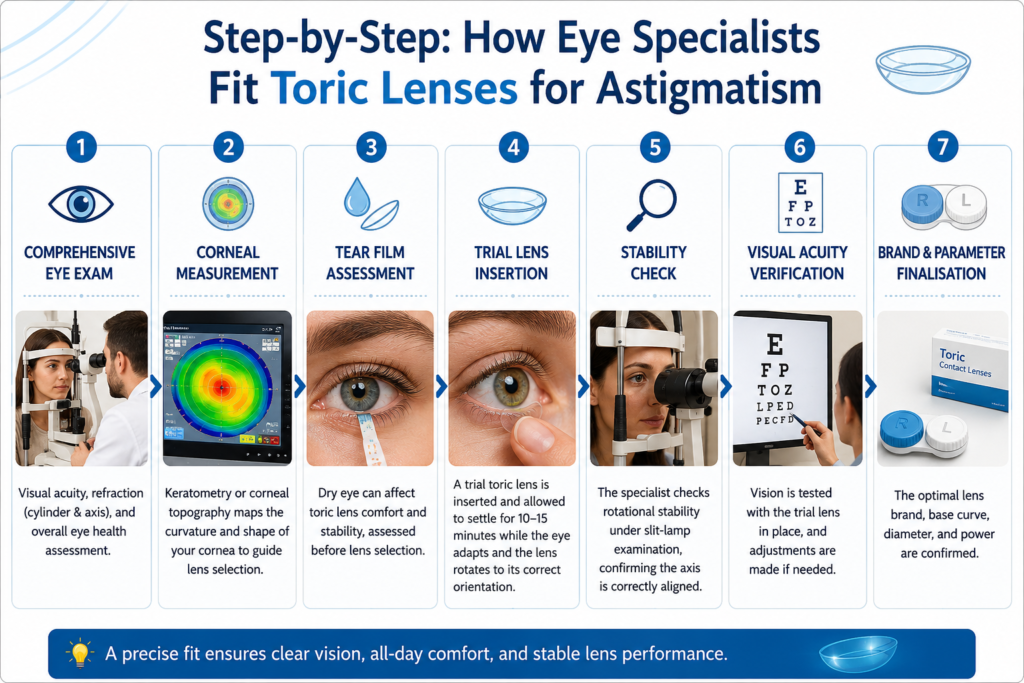
Many patients in Bangalore are unsure what a toric lens fitting actually involves, especially if they have previously been fitted for regular contacts and found the process quick and straightforward.
Toric lens fitting requires more precision, but modern techniques have made it more comfortable and efficient than ever.
Step-by-Step: How Eye Specialists Fit Toric Lenses for Astigmatism
- Step 1: Comprehensive eye exam: Visual acuity, refraction including cylinder and axis, and overall eye health assessment
- Step 2: Corneal measurement: Keratometry or corneal topography maps the curvature and shape of your cornea to guide lens selection
- Step 3: Tear film assessment: Dry eye can affect toric lens comfort and stability, assessed before lens selection
- Step 4: Trial lens insertion: A trial toric lens is inserted and allowed to settle for 10-15 minutes while the eye adapts and the lens rotates to its correct orientation
- Step 5: Stability check: The specialist checks rotational stability under slit-lamp examination, confirming the axis is correctly aligned
- Step 6: Visual acuity verification: Vision is tested with the trial lens in place, and adjustments are made if needed
- Step 7: Brand and parameter finalisation: The optimal lens brand, base curve, diameter, and power are confirmed
In some cases, 2-3 different brands may be trialled before the best fit is found. This is completely normal and is a sign of a thorough, patient-first fitting approach.
Toric or Regular Contact Lenses: Which Type Do You Need? A Quick Decision Guide
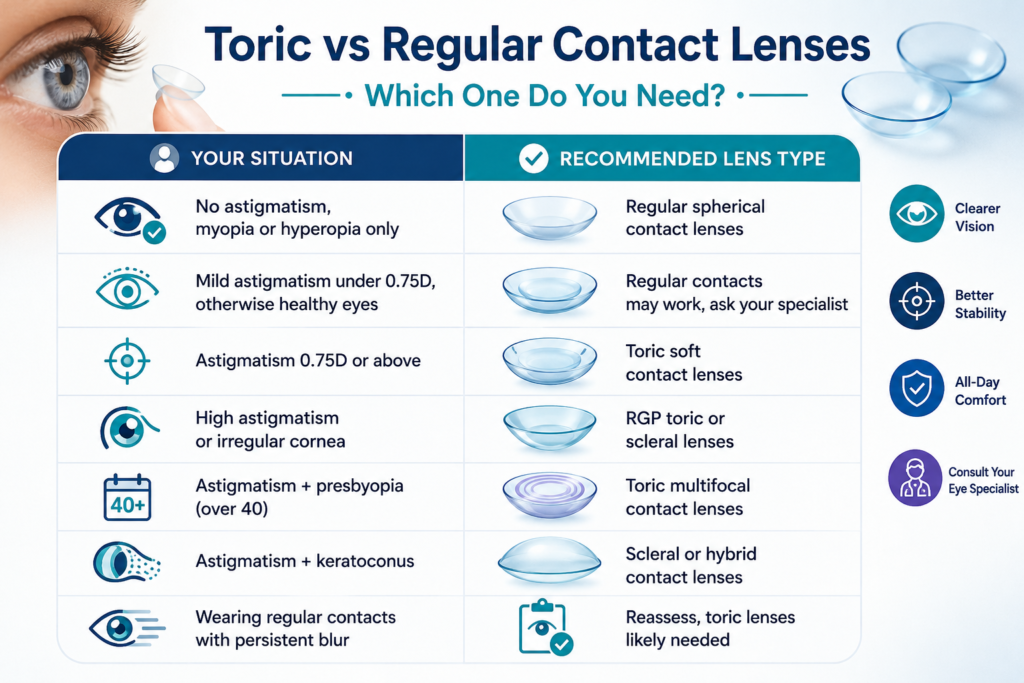
Still unsure which type of lens is right for you? This simple guide helps you figure out what your eyes most likely need, though a professional consultation is always the definitive answer.
| Your Situation | Recommended Lens Type |
| No astigmatism, myopia or hyperopia only | Regular spherical contact lenses |
| Mild astigmatism under 0.75D, otherwise healthy eyes | Regular contacts may work, ask your specialist |
| Astigmatism 0.75D or above | Toric soft contact lenses |
| High astigmatism or irregular cornea | RGP toric or scleral lenses |
| Astigmatism + presbyopia (over 40) | Toric multifocal contact lenses |
| Astigmatism + keratoconus | Scleral or hybrid contact lenses |
| Wearing regular contacts with persistent blur | Reassess, toric lenses likely needed |
Many people think lazy eye can’t be treated after childhood, but that’s not always true. Explore Lazy Eye (Amblyopia) Treatment for Adults to learn about modern therapies and recovery possibilities.
Conclusion: The Right Contact Lens for Astigmatism Makes All the Difference
Astigmatism is not a condition you have to simply ‘live with’ in blurry, strained discomfort. The difference between wearing the wrong type of lens and the right toric contact lens for astigmatism can be dramatic: sharper vision, less eye fatigue, better night vision, and a genuinely better quality of life throughout the day.
Regular spherical contact lenses correct myopia and hyperopia effectively, but they simply cannot address the irregular corneal curvature that causes astigmatism.
Toric lenses, whether soft, RGP, hybrid, or scleral, are purpose-built to correct astigmatism with precision, stability, and comfort.
If you wear contact lenses in Bangalore and experience persistent blur, headaches, or end-of-day eye strain, it is worth asking whether you are in the right type of lens.
Book a comprehensive contact lens consultation at Seedi Eye Care Centre, Bangalore, where experienced eye care specialists will assess your cornea, measure your astigmatism accurately, and fit you with the toric lens that truly matches your eyes and your lifestyle.
Clear vision is not a luxury; it is something you deserve every single day.
FAQs
1. Do you need toric contacts if you have astigmatism?
Toric contact lenses are specially designed to correct astigmatism by providing stable and precise vision correction. Mild astigmatism may sometimes work with regular lenses, but moderate to severe cases usually need toric lenses for clear vision.
2. What is the 20-20-20 rule for astigmatism?
The 20-20-20 rule helps reduce digital eye strain, often experienced by people with astigmatism. Every 20 minutes, look at something 20 feet away for at least 20 seconds to relax your eye muscles.
3. What astigmatism level requires a toric lens?
Most eye doctors recommend toric lenses when astigmatism reaches around 0.75 diopters or higher. However, the need can vary depending on symptoms, lifestyle, and how blurry your vision feels with regular lenses.
4. Do I need toric lenses for 0.25 astigmatism?
A very mild astigmatism, like 0.25, may not always require toric lenses. Many people can comfortably wear regular soft contacts if their vision remains clear and stable.
5. What happens if I wear regular contacts when I have astigmatism?
Regular contact lenses may cause blurry vision, eye strain, headaches, or difficulty focusing if you have astigmatism. Toric lenses provide better stability and sharper vision because they are designed specifically for the shape of your eye.