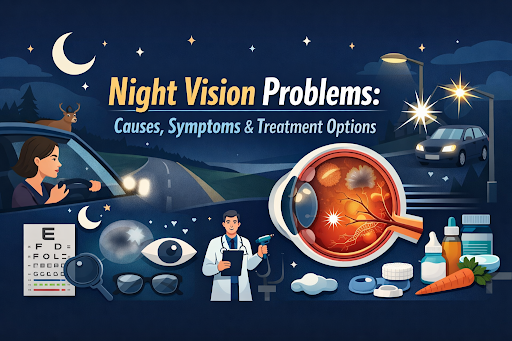
Night driving feels different when your vision isn’t quite right. Streetlights blur. Headlights sting. Shadows look thicker than they should. If you’ve noticed difficulty seeing at night, you’re not imagining it.
Night vision problems are common, and they often signal an underlying issue that needs medical attention. At Seedieye Care Centre, patients frequently seek help for poor night vision, glare while driving at night, or slow visual adjustment in dim spaces.
The good news? Most causes are diagnosable. Many are treatable. Early care makes all the difference.
What Are Night Vision Problems?
The term “night vision problems” describes the inability to see well in dim or dark conditions, particularly when driving at night or navigating between bright and dark areas.
Before we talk treatment, let’s get clear on what this condition really means.
Definition Of Night Vision Problems
Night vision problems refer to difficulty seeing clearly in low-light or dark environments. This may include trouble driving at night, walking in dimly lit areas, or adjusting after lights are turned off. It is not total blindness in darkness. Instead, it’s reduced visual performance under low illumination.
The medical term for this condition is Nyctalopia.
Nyctalopia
Nyctalopia is not a disease itself. It is a symptom. It usually indicates an issue with the retina, cornea, lens, or optic nerve. The retina, especially rod cells, plays a central role in low-light vision. When these cells malfunction, night blindness or poor night vision occurs.
How Normal Night Vision Works
Here’s the thing. Your eyes contain two types of photoreceptor cells:
- Rods – Responsible for vision in dim light
- Cones – Responsible for color and sharp daytime vision
Rods function best in darkness. They rely on a light-sensitive pigment called rhodopsin, which requires Vitamin A for proper function. When light levels drop, rods take over. If rods are damaged or underperforming, night vision symptoms appear.
It’s like switching from HD mode to backup lighting. If the backup fails, everything looks unclear.
Why Early Diagnosis Matters
Night vision problems may signal early cataracts, retinal disorders, or diabetes-related damage. Delaying evaluation can lead to progression of the disease. Early diagnosis improves outcomes and preserves long-term vision quality.
If blurred night vision is linked to cataracts, do not miss our guide on Delaying Cataract Surgery – Is There Any Risk in Postponing Cataract? to understand the risks of waiting too long.
Also Check: What Is Contoura Vision LASIK? Is It Better Than Standard LASIK?
Common Symptoms Of Night Vision Problems
Symptoms often begin subtly. Many patients dismiss them at first. But patterns emerge. Over time, these visual changes become more noticeable, especially while driving at night or moving between dimly lit environments.
Difficulty Seeing In Low Light Conditions
You may struggle in dim restaurants, movie halls, or poorly lit staircases. Objects blend into shadows. Faces look vague. The world feels hazy after sunset.
This is one of the earliest night vision symptoms.
Increased Glare From Headlights
Glare while driving at night is a major complaint. Headlights appear excessively bright. Halos may form around lights. You might squint more than usual.
Glare sensitivity is common in cataracts and post-refractive surgery disturbances.
Slow Adjustment From Light To Dark
Normally, eyes adapt within seconds when moving from bright to dark environments. In poor night vision, this adaptation is delayed. It may take minutes to see clearly.
That delay can feel disorienting.
Blurry Or Reduced Peripheral Vision
Peripheral vision loss at night is particularly concerning. Retinal conditions like retinitis pigmentosa often begin with side vision reduction.
Blurry vision at night, especially combined with narrowing fields of vision, warrants urgent evaluation.
What Causes Poor Night Vision?
Night blindness has multiple causes. Some are nutritional. Some structural. Some genetic. Let’s break them down.
Vitamin A Deficiency And Night Blindness
Vitamin A is essential for rhodopsin production. Without adequate levels, rod cells cannot function properly.
Common causes include:
- Malnutrition
- Liver disorders
- Intestinal absorption problems
Vitamin A deficiency night blindness is often reversible with supplementation.
Cataracts And Clouded Vision At Night
Cataracts cause clouding of the natural lens. Light scatters instead of focusing properly.
Symptoms include:
- Glare from headlights
- Halos around lights
- Reduced contrast sensitivity
Cataracts night vision complaints are extremely common in elderly patients.
Retinal Disorders Such As Retinitis Pigmentosa And Macular Degeneration
Retinitis pigmentosa is a genetic retinal disorder affecting rod cells first. Night blindness is often the earliest sign.
Age-related macular degeneration mainly affects central vision, but advanced stages can reduce contrast in low light.
Retinal problems are serious. Early retinal screening is essential.
Uncorrected Refractive Errors
High myopia, astigmatism, or outdated glasses can worsen poor night vision. Light scatters more at night due to larger pupil dilation.
Proper prescription correction can significantly reduce symptoms.
Diabetes Related Eye Problems
Diabetes can damage retinal blood vessels. Diabetic retinopathy affects vision quality, especially in low light.
Diabetes eye complications often progress silently. Routine screening is vital.
Post LASIK Or Post Surgery Vision Disturbances
Some patients experience glare or halos after LASIK. These symptoms usually improve over months but may persist in rare cases.
Careful LASIK evaluation reduces this risk.
Also Check: Do Eye Drops Really Work? 7 Proven Truths | 2026 Guide
Who Is At Higher Risk For Night Vision Problems?
Certain groups face a higher risk. Individuals with large pupil size in low light conditions are more prone to glare and halos after refractive surgery.
Patients with pre-existing higher-order aberrations, high myopia, or untreated dry eye may also experience more noticeable night vision disturbances, especially during the early recovery phase.
Elderly Individuals
Ageing increases cataract development and retinal degeneration risk. Natural lens changes reduce contrast sensitivity.
The crystalline lens gradually becomes denser and less transparent, which scatters incoming light and worsens glare at night.
Age-related decline in rod photoreceptor function also reduces adaptation to dim lighting conditions.
People With Diabetes
Poor glycemic control damages retinal vessels. Night blindness risk factors increase with the duration of diabetes.
Diabetic retinopathy can impair retinal blood supply, affecting the rod cell performance responsible for night vision.
Fluctuating blood sugar levels may also cause temporary changes in lens shape, leading to blurred or unstable vision in low light.
Patients With Existing Retinal Conditions
Those with retinitis pigmentosa or macular degeneration have increased difficulty seeing at night.
Retinitis pigmentosa directly affects rod photoreceptors, which are essential for dim light vision.
Macular degeneration compromises central vision and contrast sensitivity, making night tasks harder.
Individuals With High Power Glasses
High myopia stretches the retinal tissue. This increases susceptibility to retinal thinning and night vision disturbances.
Elongation of the eyeball in high myopia may predispose individuals to peripheral retinal degeneration.
Such structural changes can affect light signal transmission, especially under low illumination.
Not sure when to schedule a check-up? Our guide on Best Time to Visit an Eye Doctor in Bangalore: Signs You Shouldn’t Ignore explains the early warning symptoms you should never overlook.
How Seedieye Care Centre Diagnoses Night Vision Problems
Accurate diagnosis requires more than a simple eye chart. At Seedieye Care Centre, evaluation is comprehensive and evidence-based.
Advanced Retinal Screening
Modern retinal imaging allows early detection of subtle rod dysfunction and vascular damage.
Tools include:
- Optical Coherence Tomography
- Fundus Photography
- Visual Field Testing
Retinal screening identifies early structural changes.
Digital Eye Testing And Low Light Assessment
Night vision test protocols simulate low illumination conditions. Contrast sensitivity testing measures performance beyond standard acuity.
Digital refraction ensures precise prescription updates.
Comprehensive Eye Checkup At Seedieye Care Centre
Experienced ophthalmologists conduct detailed evaluations, including:
- Slit lamp examination
- Dilated retinal exam
- Intraocular pressure measurement
Seedieye Care Centre uses advanced diagnostic technology and evidence-based assessment to identify the root cause, not just symptoms.
Treatment Options For Night Vision Problems At Seedieye Care Centre
Treatment depends entirely on the cause. There is no single cure. That’s important to understand.
A detailed diagnostic evaluation is essential to identify the underlying issue before recommending the most appropriate and effective treatment plan.
Vitamin A Supplementation If Deficiency Based
Confirmed deficiency cases respond well to supervised supplementation. Self-medication is discouraged, as excess Vitamin A can cause toxicity.
Dosage and duration should always be determined by a qualified healthcare professional based on age, clinical signs, and laboratory findings.
Regular monitoring is essential during supplementation to prevent hypervitaminosis A, which may lead to liver damage, headaches, or bone-related complications.
Cataract Surgery For Improved Night Vision
Cataract surgery removes the clouded lens and replaces it with a clear intraocular lens.
Patients often report:
- Reduced glare
- Sharper night contrast
- Better driving confidence
Cataract surgery for night vision improvement is highly effective.
Retinal Treatment And Laser Procedures
For diabetic retinopathy:
- Laser photocoagulation
- Intravitreal injections
These treatments stabilise retinal damage and preserve functional vision.
Prescription Glasses Or Contact Lens Correction
Updated glasses reduce glare and improve clarity. Anti-reflective coating significantly helps with nighttime driving.
For patients with irregular astigmatism, specialised lenses such as toric or high-index lenses can further enhance visual sharpness and comfort.
Advanced Refractive Procedures And LASIK Evaluation
Careful screening determines if residual refractive error contributes to symptoms. LASIK for night vision issues may help selected patients.
Wavefront analysis and corneal topography are used to identify higher-order aberrations that may be corrected through customised laser enhancement procedures.
Also Check: Computer Vision Syndrome (CVS): Prevention Tips for Office Workers (2026 Guide)
Can Night Vision Problems Be Prevented?
Some causes are preventable. Others are genetic. Prevention focuses on risk control.
Regular comprehensive eye examinations, early detection of underlying conditions like cataract or vitamin A deficiency, and timely treatment can significantly reduce the risk of progressive night vision difficulties.
Regular Eye Checkups
Annual comprehensive eye exams detect early cataracts, diabetic changes, and retinal degeneration. Early detection prevents progression.
They also help monitor subtle vision changes and allow timely intervention before symptoms begin to affect daily activities.
Managing Diabetes Effectively
Maintaining HbA1c within the recommended range reduces retinal damage. Blood sugar control directly impacts night vision quality.
Regular eye examinations help detect early diabetic retinopathy changes before they begin to affect visual clarity or contrast sensitivity.
Balanced Diet For Eye Health
Include:
- Carrots
- Spinach
- Sweet potatoes
- Fish rich in omega-3
These support retinal health and may improve night vision naturally.
Protecting Eyes From UV Exposure
UV exposure accelerates cataract formation. Wear UV protective sunglasses outdoors.
Choose sunglasses that block 99 to 100 per cent of UVA and UVB rays to ensure effective protection for long-term eye health.
When Should You See An Eye Specialist?
Your eyes rarely fail without warning. Subtle changes often appear first. Ignoring them can delay diagnosis and affect long-term visual health.

Regular eye exams are important, but certain symptoms require immediate professional evaluation.
These symptoms may indicate refractive changes, cataract development, retinal disorders, glaucoma, or macular conditions. Early detection allows timely management and can prevent permanent vision loss.
If these sound familiar, schedule a consultation at Seedieye Care Centre. A comprehensive eye examination, including retinal screening, intraocular pressure measurement, and advanced diagnostic imaging, can identify underlying causes accurately.
Why Choose Seedieye Care Center For Night Vision Treatment?
Choosing the right eye hospital matters. Night vision problems can arise from multiple causes, and accurate diagnosis is critical before starting treatment.
Experienced Ophthalmologists
Specialists with expertise in retinal disorders, cataract surgery, and refractive correction lead evaluations.
Their clinical experience enables early detection of underlying conditions such as retinal degeneration or lens opacity that may impair night vision.
Advanced Diagnostic Equipment
High-resolution imaging and digital testing allow accurate diagnosis.
Technology such as retinal scans, corneal topography, and contrast sensitivity testing helps identify subtle abnormalities affecting low-light vision.
Personalised Treatment Plans
Every case differs. Treatment plans are tailored to the specific cause and patient lifestyle.
Management may include medical therapy, surgical correction, nutritional guidance, or refractive solutions depending on the diagnosis.
Comprehensive Eye Care Under One Roof
From diagnosis to surgery and follow-up, Seedieye Care Centre provides complete ophthalmic care in one facility.
Integrated services ensure continuity of care, consistent monitoring, and coordinated management for long-term visual health.
Want to strengthen your eyes naturally? Read our guide on Foods and Vitamins That Naturally Help Improve Your Vision to learn which nutrients truly support retinal health.
Conclusion – Get Expert Care For Night Vision Problems At Seedieye Care Centre
Night vision problems are more than an inconvenience. They can affect safety, independence, and quality of life. Whether the cause is vitamin A deficiency, cataracts, diabetes, or retinal disease, early diagnosis leads to better outcomes.
If you are experiencing difficulty seeing at night, glare while driving, or blurry vision at night, book a comprehensive eye checkup at Seedieye Care Centre today. Timely evaluation, advanced testing, and personalised treatment can restore clarity and protect your vision for years to come.
Frequently Asked Questions About Night Vision Problems
1. Is Night Blindness Permanent?
It depends on the cause. Vitamin A deficiency is reversible. Genetic retinal disorders may be progressive but manageable.
2. Can LASIK Cure Night Vision Problems?
LASIK can correct refractive errors but does not treat retinal disease or cataracts. Proper evaluation is necessary.
3. Does Vitamin Deficiency Cause Poor Night Vision?
Yes. Vitamin A deficiency night blindness is a well-recognised medical condition.
4. Are Night Vision Issues Age-Related?
Yes. Cataracts and retinal degeneration increase with age.
5. How Long Does Treatment Take?
Vitamin deficiency improves within weeks. Cataract surgery recovery usually takes a few days to weeks. Retinal treatments vary depending on severity.