If you’ve been living with blurry vision, thick glasses, or uncomfortable contact lenses, you’ve probably asked: Is LASIK eye surgery painful? It’s one of the most common concerns people have before booking a consultation. The good news? LASIK is largely a painless procedure, thanks to advanced laser technology and anaesthetic eye drops.
Most patients say they felt nothing more than mild pressure. In this blog, we break down the entire LASIK procedure step by step, so you know exactly what to expect before, during, and after surgery.
What Is LASIK Eye Surgery? Understanding Laser Vision Correction
Before we talk about pain, let’s understand what LASIK actually is. LASIK (Laser-Assisted In Situ Keratomileusis) is a type of refractive eye surgery that uses a precision excimer laser to reshape the cornea, the clear front surface of your eye, so that light focuses correctly on the retina.
It is one of the most commonly performed elective surgeries in the world and is used to correct:
- Myopia (nearsightedness) — difficulty seeing distant objects
- Hyperopia (farsightedness) — difficulty seeing close objects
- Astigmatism — blurred vision due to an irregularly shaped cornea
Most LASIK procedures take less than 20–30 minutes for both eyes combined, making it a quick, outpatient laser eye surgery.
Is LASIK Painful? What Patients Actually Feel
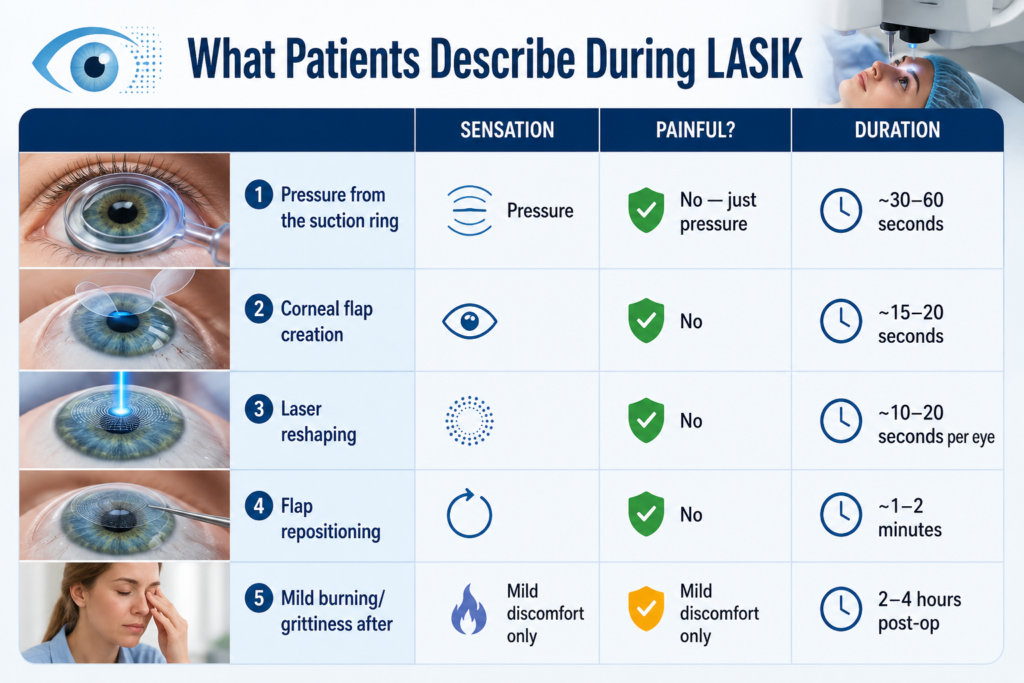
This is the big question, and the answer is reassuring. LASIK is not painful for the vast majority of patients.
Here’s why:
- Anaesthetic (numbing) eye drops are applied before the procedure, completely blocking pain signals.
- The laser reshaping itself takes only 10–20 seconds per eye.
- Patients may feel a brief sensation of pressure when the suction ring is placed, but no sharp pain.
- Some patients notice a faint smell during laser application; this is normal and not painful.
What Patients Describe During LASIK
| Sensation | Painful? | Duration |
| Pressure from the suction ring | No — just pressure | ~30–60 seconds |
| Corneal flap creation | No | ~15–20 seconds |
| Laser reshaping | No | ~10–20 seconds per eye |
| Flap repositioning | No | ~1–2 minutes |
| Mild burning/grittiness after | Mild discomfort only | 2–4 hours post-op |
The bottom line: LASIK is not something to fear. It’s fast, it’s precise, and it’s virtually pain-free during the procedure itself.
Wondering about pricing? Read our guide on LASIK Cost in Bangalore 2026 to understand what affects the cost and how to find affordable treatment options without compromising safety.
LASIK Eye Surgery Step-by-Step: What Happens on Surgery Day
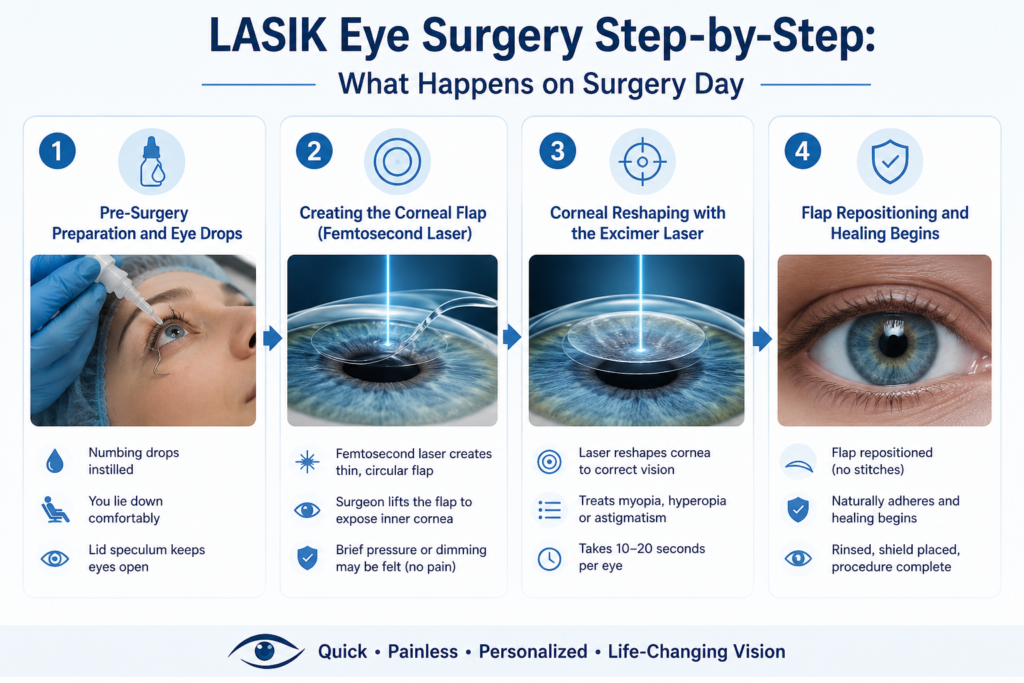
Understanding the LASIK procedure step by step can ease a lot of pre-surgery anxiety. Here’s exactly what happens from the moment you walk into the surgery suite.
Step 1: Pre-Surgery Preparation and Eye Drops
Before the laser ever touches your eye, your eye care team takes several important steps. Anaesthetic numbing drops are instilled into both eyes; these take effect in seconds and ensure you feel no pain during the procedure.
You’ll be asked to lie down comfortably under the laser system, and a lid speculum (a small, soft device) is gently placed to keep your eyelids open. You don’t need to worry about blinking; it’s taken care of for you.
Step 2: Creating the Corneal Flap (Femtosecond Laser)
This is the first active step of the surgery. A femtosecond laser (or in older techniques, a microkeratome blade) creates a thin, circular flap in the outer layer of the cornea.
The femtosecond laser is the gold standard today; it delivers rapid pulses of infrared light to create a precise layer of tiny bubbles just beneath the corneal surface, outlining the flap.
The surgeon then carefully lifts this flap to expose the inner corneal tissue. Patients often report a brief dimming of vision and a sensation of pressure at this stage, but no pain.
Step 3: Corneal Reshaping with the Excimer Laser
Once the flap is lifted, the excimer laser comes into action, and this is where the real vision correction happens.
The laser removes microscopic amounts of corneal tissue with incredible precision, guided entirely by your pre-surgery eye measurements:
- For myopia: the cornea is flattened slightly
- For hyperopia: the cornea is steepened
- For astigmatism: an irregular corneal surface is smoothed
The entire reshaping typically takes 10–20 seconds per eye. You may hear a clicking sound and notice a faint smell; this is simply the vaporisation of corneal cells.
The laser is programmed to your unique eye map, making modern LASIK a truly personalised treatment.
Step 4: Flap Repositioning and Healing Begins
After the cornea is reshaped, the surgeon carefully repositions the flap back to its original position. There are no stitches required; the flap naturally adheres to the corneal surface due to surface tension.
It acts as a natural bandage, and healing begins almost immediately. The eye is then rinsed, a protective shield is placed, and the procedure is complete. From flap to finish, the entire process per eye takes just a few minutes.
Immediately After LASIK: What Mild Discomfort Feels Like
Most patients notice improved vision within hours of surgery, but the first few hours can bring some mild, temporary sensations. These are completely normal and expected as part of LASIK recovery.
Common post-LASIK sensations include:
- Burning or stinging (lasts 1–3 hours)
- A gritty or “something in the eye” feeling
- Watery or teary eyes
- Mild sensitivity to light
- Slightly blurry or cloudy vision
These are not signs of something going wrong; they are the eye’s natural response to the procedure.
Most patients find that resting with their eyes closed for a few hours significantly eases the discomfort. Sharp or worsening pain is not normal and should be reported to your eye surgeon immediately.
Choosing the right doctor matters just as much as the procedure itself. Explore our LASIK Surgeon Checklist for Bangalore Patients before booking your consultation.
LASIK Recovery Timeline: Day by Day and Week by Week
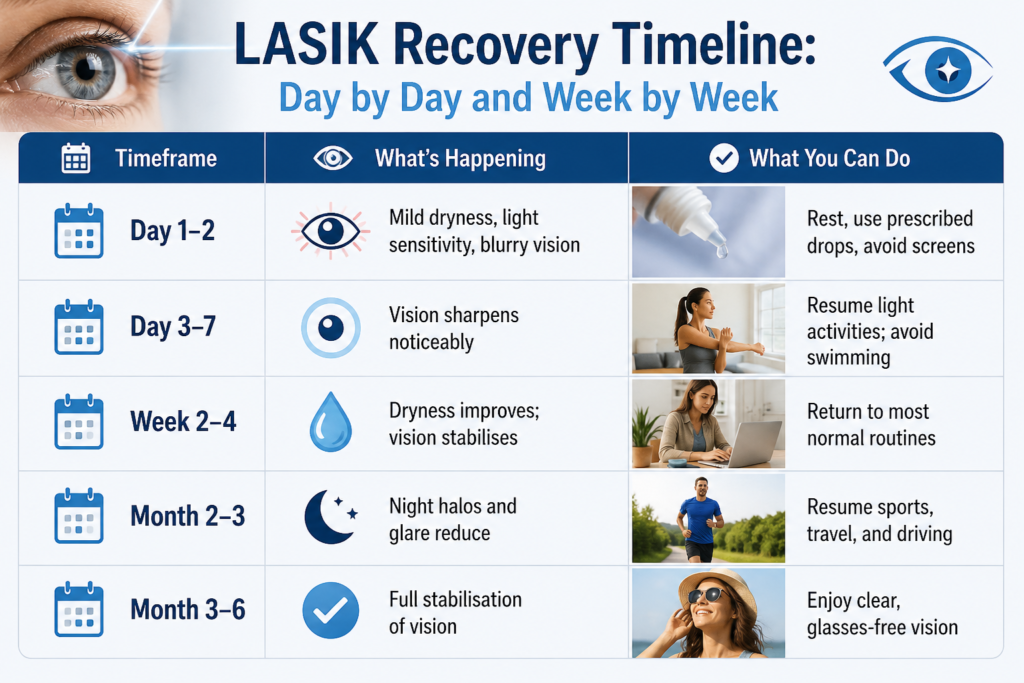
Recovery from LASIK is remarkably fast compared to most surgeries. Here’s what to expect:
| Timeframe | What’s Happening | What You Can Do |
| Day 1–2 | Mild dryness, light sensitivity, blurry vision | Rest, use prescribed drops, avoid screens |
| Day 3–7 | Vision sharpens noticeably | Resume light activities; avoid swimming |
| Week 2–4 | Dryness improves; vision stabilises | Return to most normal routines |
| Month 2–3 | Night halos and glare reduce | Resume sports, travel, and driving |
| Month 3–6 | Full stabilisation of vision | Enjoy clear, glasses-free vision |
Tips for a Smooth LASIK Recovery
- Use all prescribed eye drops, typically antibiotic, anti-inflammatory, and lubricating drops
- Wear protective sunglasses outdoors to reduce UV exposure and glare
- Do not rub your eyes; this is the most important rule for the first few weeks
- Avoid swimming pools and hot tubs for at least 2–4 weeks
- Attend all follow-up appointments as scheduled
Am I a Good Candidate for LASIK? LASIK Eligibility Criteria
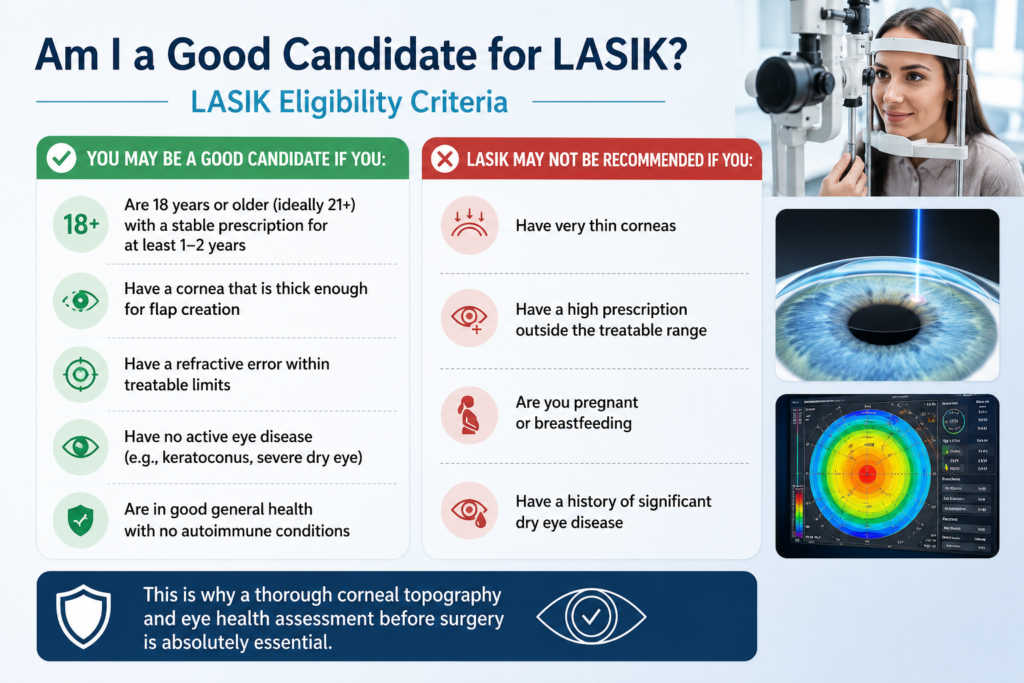
Not everyone is suitable for LASIK eye surgery. A proper pre-surgical evaluation helps determine candidacy.
You may be a good candidate if you:
- Are 18 years or older (ideally 21+) with a stable prescription for at least 1–2 years
- Have a cornea that is thick enough for flap creation
- Have a refractive error within treatable limits
- Have no active eye disease (e.g., keratoconus, severe dry eye)
- Are in good general health with no autoimmune conditions
LASIK may not be recommended if you:
- Have very thin corneas
- Have a high prescription outside the treatable range
- Are you pregnant or breastfeeding
- Have a history of significant dry eye disease
This is why a thorough corneal topography and eye health assessment before surgery is absolutely essential.
Still confused by what you’ve heard online? Discover the truth in LASIK Myths Exposed: 10 Things Bangalore Patients Get Wrong and separate facts from fear.
Why Choose Seedi Eye Care Centre, Bangalore, for LASIK Surgery
If you’re in Bangalore and considering LASIK, Seedi Eye Care Centre is a trusted name in advanced laser vision correction.
With a team of experienced ophthalmologists and state-of-the-art laser technology, Seedi Eye Care Centre offers personalised LASIK evaluations to determine whether you’re the right candidate, and which type of laser eye surgery is best suited for your eyes.
Whether you’re considering standard LASIK, Bladeless LASIK (Femto-LASIK), Contoura Vision LASIK, or SMILE, the experts at Seedi Eye Care Centre, Bangalore, guide you through every step, from your first consultation to your final follow-up.
Their commitment to patient comfort, transparent pricing, and precise surgical outcomes makes them a go-to destination for LASIK surgery in Bangalore.
LASIK vs. Other Vision Correction Options: A Quick Comparison
| Procedure | Pain Level | Recovery Time | Flap Created? |
| LASIK | Minimal | 1–2 days | Yes |
| SMILE | Minimal | 2–3 days | No |
| PRK | Moderate (3–5 days) | 1–2 weeks | No |
| Femto-LASIK (Bladeless) | Minimal | 1–2 days | Yes (laser only) |
| ICL (Lens Implant) | Minimal | 1–3 days | No |
LASIK remains the most popular choice due to its quick procedure time, fast visual recovery, and minimal discomfort compared to PRK or traditional surgery.
Think you’re “too old” for LASIK? Learn what specialists say in Can You Get LASIK After 40? What Eye Doctors Want You to Know.
Conclusion
So, is LASIK painful? The answer is a clear no, for the vast majority of patients, LASIK is a quick, comfortable, and highly effective procedure. The combination of anaesthetic drops, advanced laser technology, and experienced surgeons ensures that what you’ll feel is little more than mild pressure, followed by some temporary dryness or light sensitivity in the hours after.
The entire LASIK journey, from pre-surgery assessment to full recovery, is far more manageable than most people expect. If you’re ready to explore clear, glasses-free vision, reach out to Seedi Eye Care Centre, Bangalore, for a personalised LASIK consultation today. Clear vision is closer than you think.
FAQs
Can you feel the laser during LASIK?
No. You cannot feel the excimer laser working. You may hear clicks and notice a brief smell, but the numbing drops prevent any sensation of pain.
Does LASIK hurt more than PRK?
No, LASIK is generally considered less uncomfortable than PRK. In PRK, the surface epithelium is removed entirely, leading to more post-operative discomfort for 3–5 days.
What happens if I blink during LASIK?
The lid speculum keeps your eye open, so blinking is physically prevented during the laser application. The system also has an eye-tracking feature that follows your eye movements in real-time.
How long does the LASIK procedure take?
The entire procedure for both eyes typically takes 15–30 minutes, with the laser running for only 10–20 seconds per eye.
Is LASIK permanent?
For most patients, yes, LASIK permanently reshapes the cornea. However, age-related vision changes (like presbyopia) may still occur later in life.