Picture this: you are 42, squinting at a restaurant menu, holding your phone at arm’s length just to read a text. Your friends got LASIK in their 20s and swear by it. You wonder, is it too late for me?
Here is the good news: LASIK after 40 is absolutely possible. There is no upper age cutoff, and thousands of patients in their 40s, 50s, and beyond have successfully undergone the procedure. But eyes after 40 behave differently, and presbyopia, the age-related stiffening of the eye’s internal lens, changes what LASIK can and cannot do for you.
This blog covers exactly what changes after 40, whether LASIK still works, what options like monovision LASIK offer, and what patients considering LASIK surgery after 40 in Bangalore should know before booking a consultation.
What Changes In Your Eyes After 40?
Understanding why age matters is the first step toward setting realistic expectations. The changes are biological, not a sign of disease, and knowing them helps you make an informed decision about LASIK over 40.
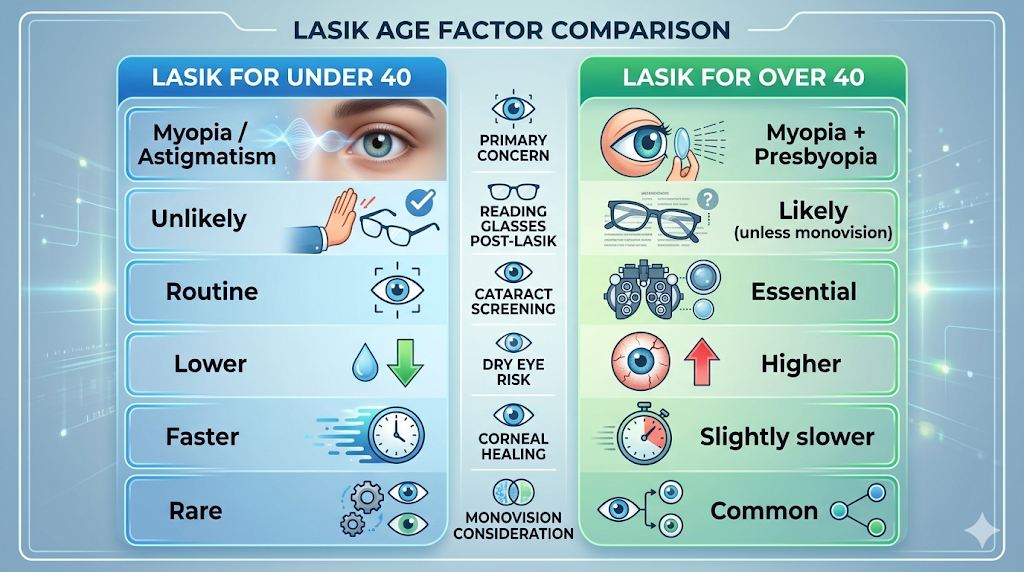
Around the age of 40, the natural lens inside your eye begins to stiffen. Throughout your 20s and 30s, this lens flexes easily, snapping from distance focus to near focus within milliseconds. After 40, that flexibility gradually disappears.
This condition is called presbyopia. It affects virtually everyone between the ages of 40 and 50. It is not a disease; it is a predictable part of human biology. Presbyopia is why you suddenly need reading glasses, even though your distance vision may still be perfectly fine.
Important distinction: LASIK reshapes the cornea, the clear outer surface of the eye. It does not touch the internal lens. This means LASIK cannot prevent, reverse, or cure presbyopia.
Here is the nuance worth understanding: LASIK still works after 40, it just solves a different problem than it would have at 25. At 25, LASIK largely eliminated glasses.
Spending hours on screens? Find out whether blue light glasses actually work or if they’re just a trend.
Can You Actually Get LASIK After 40?
This is the question most 40-plus patients come in asking. The answer is direct, encouraging, and worth understanding in full before you book a consultation.
Yes. There is no FDA-mandated upper age limit for LASIK. The procedure is not restricted by birthday; it is guided by eye health. Patients in their 40s, 50s, and even 60s successfully undergo LASIK every year around the world, including right here in Bangalore.
The real question to ask is not ‘can I get LASIK after 40?’ but rather ‘what should I realistically expect from LASIK at my age?’ That is a very different, and far more useful, question.
LASIK after 40 can still effectively correct:
- Myopia (nearsightedness)
- Hyperopia (farsightedness)
- Astigmatism
What it will not do automatically is eliminate the need for reading glasses caused by presbyopia. That is where the treatment strategy needs to be customised, and where monovision LASIK enters the picture.
What Is Monovision LASIK? (And Why It Matters After 40)
Monovision LASIK is the most widely used strategy for patients over 40 who want to reduce dependence on both distance and reading glasses.
Understanding how it works and whether it suits you is central to any LASIK decision after 40.
How Monovision LASIK Works
The concept is elegant in its simplicity. Rather than correcting both eyes identically for distance, monovision LASIK deliberately creates a visual split:
- One eye (usually the dominant eye) is corrected for clear distance vision
- The other eye is corrected for near or intermediate vision
- The brain learns to blend both images, providing functional vision across a range of distances
Think of it as a built-in compromise. Neither eye is doing everything alone; the brain does the integration. Most patients adapt within a few weeks and find the result comfortably liberating for daily life.
Who Is Monovision LASIK Best Suited For?
Monovision LASIK is not for everyone, but for the right patient, it can be genuinely life-changing. Here is who tends to do best:
- Patients in their early-to-mid 40s, the brain adapts more easily at this stage
- People are comfortable with a slight trade-off in depth perception at extreme distances
- Those who have trialled monovision contact lenses for 1–2 weeks and tolerated them well
- Active individuals and professionals who want freedom from glasses for most daily tasks
Practical tip: Most surgeons recommend trialling monovision with contact lenses for 1–2 weeks before committing to surgery. This gives you a realistic preview of the visual compromise, before it’s permanent.
A fair word of honesty: monovision LASIK is a compromise. Distance sharpness in both eyes simultaneously won’t be razor-perfect. Night driving and certain precision tasks may be slightly affected.
But for the majority of patients, the trade-off comfortably beats carrying reading glasses to every meeting, meal, and movie.
LASIK Eligibility Checklist For Patients Over 40
Before booking a consultation, it helps to do a quick self-assessment. While only a comprehensive clinical evaluation can confirm suitability, these are the key factors surgeons examine when assessing LASIK age limit eligibility.
- Stable prescription for at least 12 months: Prescription changes mean the eye is still shifting; surgery needs a stable target
- Adequate corneal thickness: Measured during pre-op evaluation using corneal topography
- No active eye infections, inflammation, or severe dry eye: Corneal healing depends on a healthy ocular surface
- No keratoconus or irregular corneal shape: Irregular corneas are a contraindication for standard LASIK
- Controlled systemic health: Uncontrolled diabetes or active autoimmune conditions may disqualify candidates
- Not pregnant or breastfeeding: Hormonal changes affect corneal shape and prescription stability
- No early-stage cataracts: Critical after 40, early lens clouding changes the recommended surgical approach entirely
- Realistic expectations about presbyopia: Understanding what LASIK will and won’t fix is essential for post-surgery satisfaction
Think lazy eye can’t be treated after childhood? Learn how adults can still improve vision with modern treatment options.
Benefits Of Getting LASIK After 40
There are compelling reasons why patients in their 40s choose LASIK, and the benefits extend well beyond just clearer distance vision. Here is what patients consistently report after presbyopia LASIK and standard LASIK over 40.
Reduced dependence on distance glasses is the most immediate benefit. Whether you are playing tennis, travelling, or simply walking into a room, not reaching for glasses every few minutes is a genuine quality-of-life upgrade.
Over a lifetime, LASIK also makes strong financial sense. Progressive lenses, annual frame updates, contact lens supplies, and solution costs accumulate significantly. A one-time LASIK investment often pays for itself within three to five years.
With monovision LASIK, many patients in their 40s also reduce their dependence on reading glasses for everyday tasks, emails, menus, phone screens, even if they still occasionally reach for them in low light or for extended reading.
Additional benefits that patients frequently highlight:
- Quick procedure: typically 15–20 minutes for both eyes
- Fast recovery: most patients return to work within 1–2 days
- Blade-free femtosecond laser technology has made LASIK safer and more precise than it was a decade ago
- Significant confidence boost and lifestyle improvement reported consistently in post-surgery surveys
Risks And Limitations Specific To LASIK After 40
Transparency is central to good eye care. LASIK after 40 carries a strong safety record, but it also comes with age-specific considerations that every patient deserves to understand before making a decision.
Presbyopia Will Still Progress
LASIK permanently reshapes the cornea during the surgery day. However, the natural lens inside the eye continues to age after surgery.
Even after successful monovision LASIK, reading glasses may become necessary again in the late 50s or 60s as presbyopia advances further. LASIK does not pause the biological clock.
Dry Eye Concerns
Dry eye is one of the most common post-LASIK side effects, and the risk increases with age. After 40, tear production naturally declines. LASIK can temporarily reduce corneal sensation, further affecting tear production in the months after surgery.
- Most patients manage well with preservative-free artificial tears for 4–12 weeks post-surgery
- Pre-existing moderate-to-severe dry eye may disqualify a candidate
- A thorough tear film assessment during pre-op evaluation is non-negotiable for 40-plus patients
Early Cataracts Can Complicate Things
This is perhaps the most critical age-related factor. After 40, early lens changes, even those not yet affecting vision, can show up on pre-op screening. If early cataracts are detected, LASIK is typically not recommended.
In these cases, refractive lens exchange (RLE) or cataract surgery with premium intraocular lenses (IOLs) is a safer, more comprehensive solution.
Vision Regression
A small percentage of LASIK patients, roughly 2 to 5%, experience mild prescription regression over many years. This is not unique to patients over 40, but it is worth knowing upfront.
Enhancement procedures can address regression when it occurs, and most surgeons discuss this possibility during the pre-op consultation.
Alternatives To LASIK For Patients Over 40
LASIK is not the only path to visual freedom after 40. Depending on your corneal health, prescription, and lifestyle goals, one of these alternatives may actually be the better or the best option for you.
Refractive Lens Exchange (RLE)
RLE replaces the eye’s natural lens with an artificial intraocular lens (IOL). It is particularly well-suited for patients over 50 or those with early cataract signs.
- Corrects distance and near vision depending on the IOL type selected (monofocal, multifocal, toric, or extended depth of focus)
- Eliminates the need for future cataract surgery since the natural lens is already replaced
- An excellent option when corneal thickness or shape makes LASIK unsuitable
PRK (Photorefractive Keratectomy)
PRK achieves a similar visual outcome to LASIK but without creating a corneal flap. It is better suited for patients with thinner corneas who would not be safe candidates for standard LASIK.
- No flap means a lower risk of flap-related complications
- Longer recovery: 1 to 2 weeks versus 1 to 2 days for LASIK
- Monovision can also be applied with PRK for presbyopia management
ICL (Implantable Collamer Lens)
ICL involves placing a thin lens inside the eye, between the natural lens and the iris, without removing any corneal tissue. It is reversible and particularly useful for high prescriptions that LASIK cannot fully correct.
- Does not alter corneal shape, preserving natural tissue
- Suitable for high myopia beyond the safe range of LASIK
- Can be combined with other procedures for comprehensive correction
LASIK After 40 Cost In Bangalore
Cost is a practical and legitimate consideration. Here is what patients seeking LASIK surgery after 40 in Bangalore should know about pricing, without any hidden surprises.
LASIK cost in Bangalore generally ranges from Rs. 20,000 to Rs. 1,20,000 for both eyes. The wide range reflects significant differences in technology type, surgeon experience, and clinic infrastructure, not just marketing.
Key factors that affect the cost:
- Type of laser platform, standard microkeratome blade vs. blade-free femtosecond vs. wavefront-guided or topography-guided
- Surgeon experience and specialisation
- Depth of pre-operative diagnostics included in the package
- Post-operative care and follow-up visits
Monovision LASIK typically falls within the same price range as standard LASIK since the customisation lies in the treatment plan, not additional hardware.
At Seedi Eye Care Centre, LASIK starts from Rs. 20,000 for both eyes, with no compromise on diagnostic quality or safety standards. EMI and financing options are available; ask during your consultation.
What To Expect During Your Consultation At Seedieye
Knowing what happens at a LASIK consultation removes the anxiety of the unknown. Here is exactly what to expect at Seedi Eye Care Centre, a process designed for thorough evaluation, not rushed decisions.
Your consultation at Seedi Eye Care Centre is a comprehensive evaluation, not a quick sales conversation. Here is the step-by-step process:
- Comprehensive eye examination: Visual acuity, refraction, and slit-lamp assessment
- Corneal topography and pachymetry: Mapping the cornea’s shape and measuring thickness
- Tear film assessment: Critical for identifying dry eye risk before surgery
- Cataract and glaucoma screening: Essential for every patient over 40
- Presbyopia evaluation and dominant eye testing: Foundational for monovision planning
- Discussion of your visual goals: Eliminating distance glasses, reducing reading glass dependence, or both
- Monovision contact lens trial recommendation if you are a suitable candidate
- Honest outcome assessment: If LASIK is not the right fit, the team will tell you and recommend the appropriate alternative
The entire consultation typically takes 90 to 120 minutes. You will leave with a clear picture of your options, realistic outcome expectations, and a personalised recommendation, not a hard close.
Still experiencing blurry vision even with glasses? Discover the real reasons behind blurry eyesight and what it could mean for your eye health.
Final Thoughts
LASIK after 40 is not only possible; it is a well-established, thoroughly safe option for the right candidate. The key difference from your 20s is not eligibility; it is expectation management.
Presbyopia is real, it progresses, and no corneal procedure reverses it. But with the right approach, standard LASIK, monovision LASIK, or an alternative like RLE, visual freedom after 40 is genuinely within reach.
Do not let a birthday stop you from exploring your options. Let a thorough, honest evaluation at Seedi Eye Care Centre guide the decision. Your eyes are unique; your treatment plan should be too.
FAQs | LASIK After 40
Is there an age limit for LASIK surgery?
No. There is no FDA-mandated or officially recognised upper age limit for LASIK. Eligibility is determined by eye health, specifically corneal condition, prescription stability, and the absence of disqualifying conditions like early cataracts. Age itself is not the deciding factor.
Can LASIK fix reading vision after 40?
Standard LASIK corrects distance vision. Monovision LASIK can meaningfully reduce dependence on reading glasses by correcting one eye for near vision. However, it is a trade-off, not a complete elimination of presbyopia.
Will I still need reading glasses after LASIK?
If you are over 40 and both eyes are corrected for distance, yes, reading glasses are still likely for close work. Monovision LASIK significantly reduces this dependence for most daily tasks.
What is monovision LASIK?
Monovision LASIK is a technique where one eye (usually dominant) is corrected for distance, and the other is corrected for near or intermediate vision. The brain adapts to blend both inputs, providing functional vision across a range of distances.
Is LASIK after 40 more risky than at 25?
Not more risky, but more complex. Age-related factors like increased dry eye risk and early lens changes require more thorough pre-operative screening. With proper evaluation by an experienced surgeon, outcomes for LASIK over 40 are excellent and comparable.
How long does LASIK last after 40?
The corneal reshaping performed during LASIK is permanent. However, the eye continues to age independently of the surgery. Presbyopia will progress, and cataracts may develop in later years.
What if I have early cataracts? Can I still get LASIK?
In most cases, no. If early cataracts are detected during pre-op screening, LASIK is not recommended because the cataract will eventually reduce vision regardless of corneal correction.
How much does LASIK after 40 cost in Bangalore?
LASIK surgery after 40 in Bangalore ranges from Rs. 20,000 to Rs. 1,20,000 for both eyes, depending on the technology platform and clinic. At Seedi Eye Care Centre, pricing starts from Rs. 20,000 with no compromise on diagnostic thoroughness or surgical precision.