Early Cataract Signs Guide – Most people assume cataracts only happen to the elderly. The truth? The earliest changes in your eye’s lens can begin as early as your 40s, often silently, without obvious symptoms. By the time most people notice something is wrong, the cataract has already been developing for years.
If you are in your 40s or 50s and noticing subtle changes in your vision, difficulty reading in dim light, unexpected glare at night, or colours that look duller than they used to, this blog is for you. Learn the early signs of cataracts, why they happen, and when it is time to act.
What Are Cataracts? Understanding the Clouding of Your Eye Lens
Before spotting the warning signs, it helps to understand what a cataract actually is.
Many people picture it as a film or layer growing over the eye, but the reality is different, and understanding it helps you take it more seriously.
How Cataracts Form Inside the Eye’s Natural Lens
Your eye contains a natural lens, sitting just behind the iris and pupil. In a healthy eye, this lens is crystal clear, allowing light to pass through and focus sharply on the retina.
As you age, proteins inside the lens naturally break down and begin to clump together, creating cloudy patches. This is what we call a cataract.
- The lens clouding starts small and gradually spreads across more of the lens
- Cataracts usually develop in both eyes, though often at different rates
- Age-related cataracts are most common, but they can also result from diabetes, UV exposure, steroid use, or eye injury
- The process is slow, which is why early detection through routine eye exams is so important
Think of it like a clear glass window slowly frosting over. At first, you barely notice. But as the frost spreads, everything looks hazier and dimmer.
Poor lens hygiene can seriously harm your eyes. Discover the hidden risks in Contact Lens Care Mistakes: 7 Dangerous Eye Damage Risks.
Can You Get Cataracts in Your 40s? Early Onset Cataract Symptoms Explained
This is one of the most searched questions about cataracts, and the answer surprises many people.
You can absolutely develop early-stage cataracts in your 40s and 50s, even if your vision still feels relatively normal.
Why Your 40s Are a Critical Time for Cataract Risk Awareness
While fully symptomatic cataracts are more common after 60, the microscopic lens changes that lead to them often begin in the 40s.
At this stage, symptoms are subtle and easy to dismiss as normal ageing or tiredness. That is precisely why so many people miss them.
Risk factors that accelerate early cataract development include:
- Uncontrolled diabetes, high blood sugar directly accelerates lens protein breakdown
- Prolonged exposure to UV radiation is a significant risk for people living in sunny cities like Bangalore
- Long-term use of corticosteroid medications
- Smoking and excessive alcohol consumption
- Previous eye injury or eye surgery
- Family history of early cataracts
Important: Nearly everyone will develop cataracts if they live long enough. Understanding early risk factors in your 40s gives you the best chance to slow their progression.
Early Signs of Cataracts: 7 Cataract Symptoms You Should Not Ignore
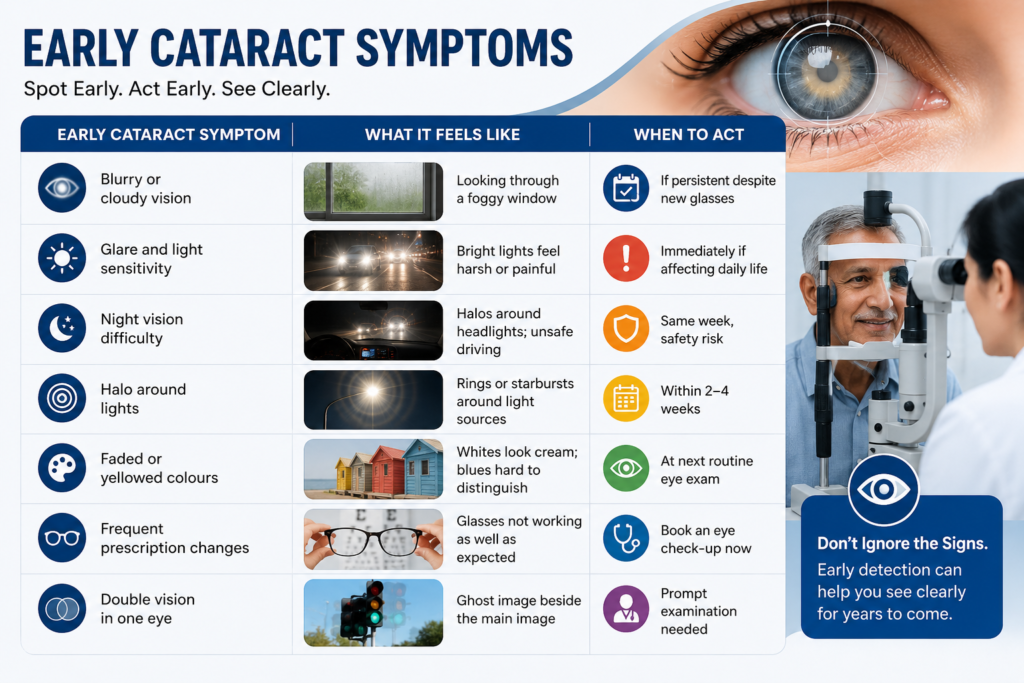
The early signs of cataracts are often subtle, easy to mistake for simple tiredness, an outdated glasses prescription, or normal ageing.
Here are the seven most common early warning signs that warrant a professional eye examination.
1. Blurry or Cloudy Vision: The First and Most Common Cataract Symptom
The earliest and most universal sign of cataracts is a gradual blurring or cloudiness of vision.
It often feels as though you are looking through a slightly foggy or smudged window that you cannot wipe clean.
- The blurring tends to worsen in bright sunlight or very dim conditions
- It may affect one eye more noticeably than the other initially
- Simply updating your glasses prescription may temporarily improve clarity in the early stages
2. Increased Sensitivity to Light and Glare: A Telltale Cataract Warning Sign
If headlights, lamps, or sunlight seem unusually harsh and uncomfortable, this is a significant early sign of cataracts.
The clouded lens scatters incoming light rather than focusing it cleanly, creating glare and a general sense of being dazzled.
- Bright sunlight may feel physically uncomfortable, even with sunglasses
- Indoor lighting that previously seemed normal may feel harsh or irritating
- Oncoming headlights while driving at night may create intense, blinding glare
3. Difficulty Driving at Night: How Cataracts Affect Night Vision
Night vision is one of the first things to deteriorate with early cataracts.
Many patients in their 40s and 50s begin to notice that driving after dark feels increasingly unsafe, and they are right to be concerned.
- Halos around streetlights, traffic signals, and headlights are a classic cataract symptom
- Objects in low-light conditions appear less defined and harder to judge
- The eye struggles to adjust between darkness and oncoming bright lights
If you have started avoiding night driving or feel anxious behind the wheel after dark, book an eye examination. Do not wait for symptoms to worsen.
4. Seeing Halos Around Lights: Cataract-Related Visual Disturbances
Halos around light sources, rings of light appearing around lamps, streetlights, or candles, are a direct result of the clouded lens diffracting light in irregular patterns.
This symptom is often most noticeable at night or in dimly lit rooms.
- Halos may appear as soft glowing rings or bright starburst patterns
- They worsen as the cataract progresses
- Halos are also associated with glaucoma; a professional examination can confirm the cause
5. Colours Appearing Faded or Yellowish: Cataract’s Effect on Colour Perception
One of the less obvious but very telling early signs of cataracts is a change in how colours appear.
The clouding lens develops a yellowish or brownish tint over time, which filters the colours you see.
- Whites may appear cream or slightly yellow
- Blues and purples may be harder to distinguish
- Colours that once seemed vivid and saturated may appear muted or brownish
- Many patients only notice this change after cataract surgery, when colour vision is dramatically restored
6. Frequent Changes in Glasses or Contact Lens Prescription
In the early stages of cataracts, the changing density of the lens can temporarily shift your refractive error.
This sometimes creates a frustrating pattern of needing increasingly frequent prescription updates, even though the lenses are not helping as much as they once did.
- Some patients even temporarily experience ‘second sight’, a brief, surprising improvement in near vision as the cataract changes the lens shape
- This improvement is temporary and followed by continued worsening
- Frequent prescription changes in your 40s or 50s should always trigger an investigation for early cataracts
7. Double Vision or Ghost Images in One Eye
Double vision is typically associated with muscle or brain conditions, but cataracts can also cause a form of monocular diplopia (double vision in a single eye).
This happens when the uneven clouding of the lens creates multiple refractive surfaces, producing a second ghost image.
- Closing one eye may eliminate the double vision if it is cataract-related
- Ghost images can appear in various positions, above, beside, or overlapping the primary image
- This symptom, when new, always requires a prompt eye examination to confirm the cause
| Early Cataract Symptom | What It Feels Like | When to Act |
| Blurry or cloudy vision | Looking through a foggy window | If persistent despite new glasses |
| Glare and light sensitivity | Bright lights feel harsh or painful | Immediately if affecting daily life |
| Night vision difficulty | Halos around headlights; unsafe driving | Same week, safety risk |
| Halo around lights | Rings or starbursts around light sources | Within 2-4 weeks |
| Faded or yellowed colours | Whites look cream; blues hard to distinguish | At next routine eye exam |
| Frequent prescription changes | Glasses not working as well as expected | Book an eye check-up now |
| Double vision in one eye | Ghost image beside the main image | Prompt examination needed |
Thinking about vision correction surgery? Explore LASIK Cost in Bangalore 2026: Proven Affordable Guide before making a decision.
Cataracts vs Normal Age-Related Vision Changes After 40: How to Tell the Difference
Not every vision change after 40 is a cataract. Presbyopia, the gradual loss of near-focusing ability, is a universal age-related change that affects everyone.
Understanding the difference helps you know when to be concerned.
Presbyopia vs Cataracts: Key Differences in Symptoms
| Feature | Presbyopia (Normal Ageing) | Early Cataract |
| Age of onset | Typically 40-45 years | Can begin in 40s; varies |
| Vision affected | Near vision (reading difficulty) | Distance and near vision |
| Colour changes | None | Colours appear dull or yellowish |
| Glare/halos | Rare | Very common, especially at night |
| Fixed with glasses | Yes, reading glasses help | Partially, worsens over time |
| Night vision | Minimally affected | Significantly affected |
Cataract Screening in Bangalore: Why Early Diagnosis at Seedi Eye Care Centre Matters
Cataracts are treatable, but early detection is the key to protecting your quality of life and avoiding unnecessary vision loss.
If you are in your 40s or 50s and experiencing any of the symptoms described in this blog, a professional cataract screening at Seedi Eye Care Centre in Bangalore is the most important step you can take.
Seedi Eye Care Centre offers comprehensive cataract evaluations using advanced diagnostic technology that detects even the earliest lens changes, changes that are invisible to a basic vision test.
Their experienced ophthalmologists can determine exactly how far a cataract has progressed and advise the right management approach for your stage and lifestyle.
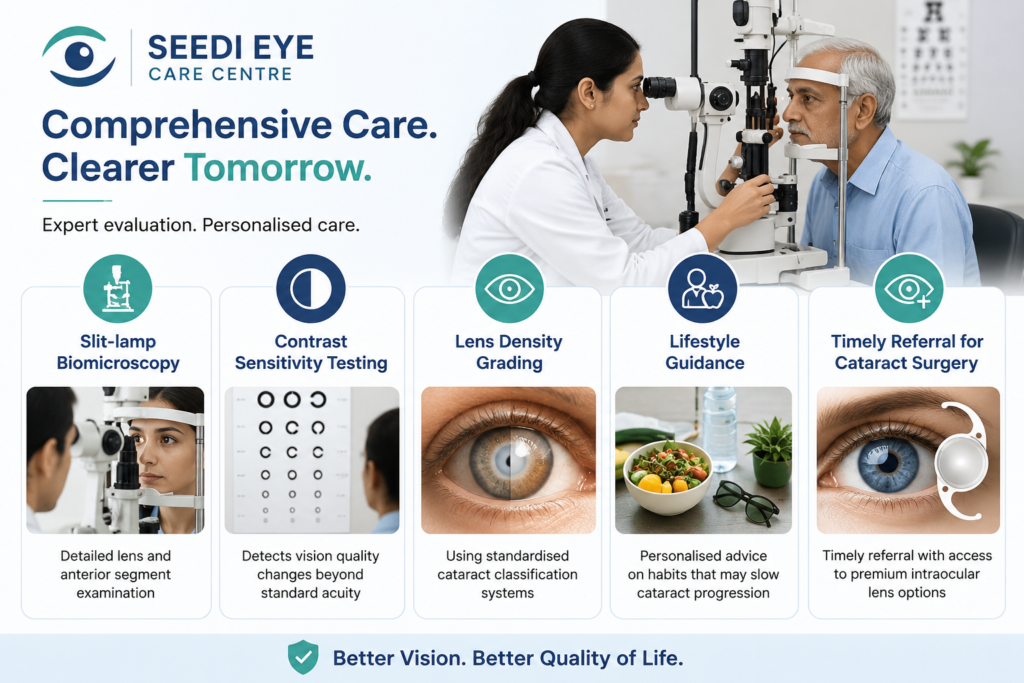
At Seedi Eye Care Centre, patients receive:
- Slit-lamp biomicroscopy for detailed lens and anterior segment examination
- Contrast sensitivity testing to detect vision quality changes beyond standard acuity
- Lens density grading using standardised cataract classification systems
- Personalised guidance on lifestyle changes that may slow cataract progression
- Timely referral for cataract surgery when clinically appropriate, with access to premium intraocular lens options
Tip from Seedi Eye Care Centre: Annual comprehensive eye exams after age 40 are the single most effective tool for catching cataracts early, long before they affect your daily life.
Wondering if age affects LASIK eligibility? Learn what specialists recommend in Can You Get LASIK After 40? What Eye Doctors Want You to Know.
How Are Early Cataracts Diagnosed? What to Expect at a Cataract Eye Exam
Many people avoid eye exams because they do not know what to expect. A cataract screening is painless, non-invasive, and takes less than 30 minutes.
Here is what the process typically involves.
Diagnostic Tests Used to Detect Early Cataract Symptoms
- Visual acuity test: Measures how sharply you see at various distances using a standard eye chart
- Slit-lamp examination: A microscope with a thin beam of light allows the ophthalmologist to examine the lens in fine detail, identifying the location, type, and density of any clouding
- Dilated eye examination: Drops widen the pupil so the doctor can examine the full lens and the retina behind it
- Contrast sensitivity test: Assesses how well you distinguish objects from their background, often affected early in cataract development before standard acuity changes
- Glare testing: Evaluates how glare affects your functional vision, directly relevant to cataract-related driving and night vision complaints
Can You Slow Down Cataract Progression? Lifestyle Tips for Eye Lens Health in Your 40s
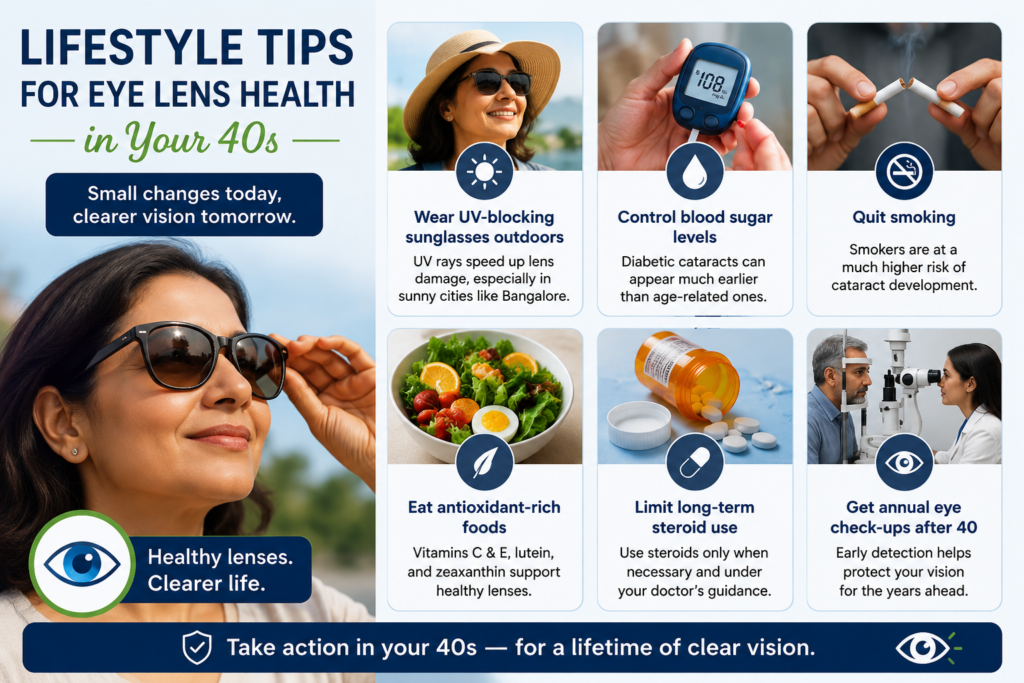
While no proven method can completely prevent age-related cataracts, certain lifestyle choices can meaningfully reduce your risk of early onset and slow progression.
Taking action in your 40s is far more effective than waiting until symptoms become disabling.
- Wear UV-blocking sunglasses outdoors: UV radiation is a major accelerator of lens protein breakdown, especially in a sun-intense city like Bangalore
- Control blood sugar levels rigorously if you have diabetes: Diabetic cataracts can appear a decade earlier than age-related ones
- Quit smoking: Smokers have a significantly higher rate of cataract development than non-smokers
- Eat a diet rich in antioxidants: Vitamins C and E, lutein, and zeaxanthin (found in leafy greens, citrus, and eggs) support lens health
- Reduce long-term steroid use where medically possible: Discuss alternatives with your doctor
- Schedule annual dilated eye exams after age 40 to catch changes before they affect your vision
Experiencing cloudy vision or trouble focusing? Read Why Are My Eyes Blurry? to uncover the common causes behind sudden vision changes.
Conclusion: Do Not Wait for Vision Loss, Act on Early Cataract Signs Now
Cataracts are not just an old-age problem. The lens changes that eventually rob people of their sharp, vibrant vision begin decades earlier, quietly, gradually, and without dramatic warning.
The seven early signs covered in this blog, from cloudy vision and glare sensitivity to colour fading and frequent prescription changes, are your body’s way of signalling that something needs attention.
The good news is that when caught early, cataracts are entirely manageable. With the right monitoring and timely treatment, patients go on to enjoy clear, comfortable vision for many years.
If you are in your 40s or 50s in Bangalore and have not had a comprehensive eye exam recently, now is the right time. Book a cataract screening at Seedi Eye Care Centre and give your eyes the attention they deserve, before vision changes become vision loss.
FAQs
1. Is it normal to get cataracts in your 50s?
Yes, cataracts commonly begin developing in your 40s and 50s as part of the natural aging process. Early detection and regular eye checkups can help manage vision changes effectively.
2. How to tell if cataracts are starting?
Early signs include blurry vision, trouble seeing at night, sensitivity to light, and faded colors. Some people also notice frequent changes in their eyeglass prescription.
3. Why do I have cataracts at 40?
Cataracts can develop earlier due to factors like diabetes, smoking, excessive UV exposure, steroid use, or family history. Lifestyle habits and overall eye health also play an important role.
4. What do stage 1 cataracts look like?
Stage 1 cataracts are usually mild and may cause slight cloudiness in vision without severe symptoms. Many people experience glare from lights or difficulty reading small text initially.
5. Can too much screen time cause cataracts?
Screen time itself does not directly cause cataracts, but prolonged digital exposure can lead to eye strain and dryness. Protecting your eyes from UV rays and maintaining healthy habits is more important for cataract prevention.